

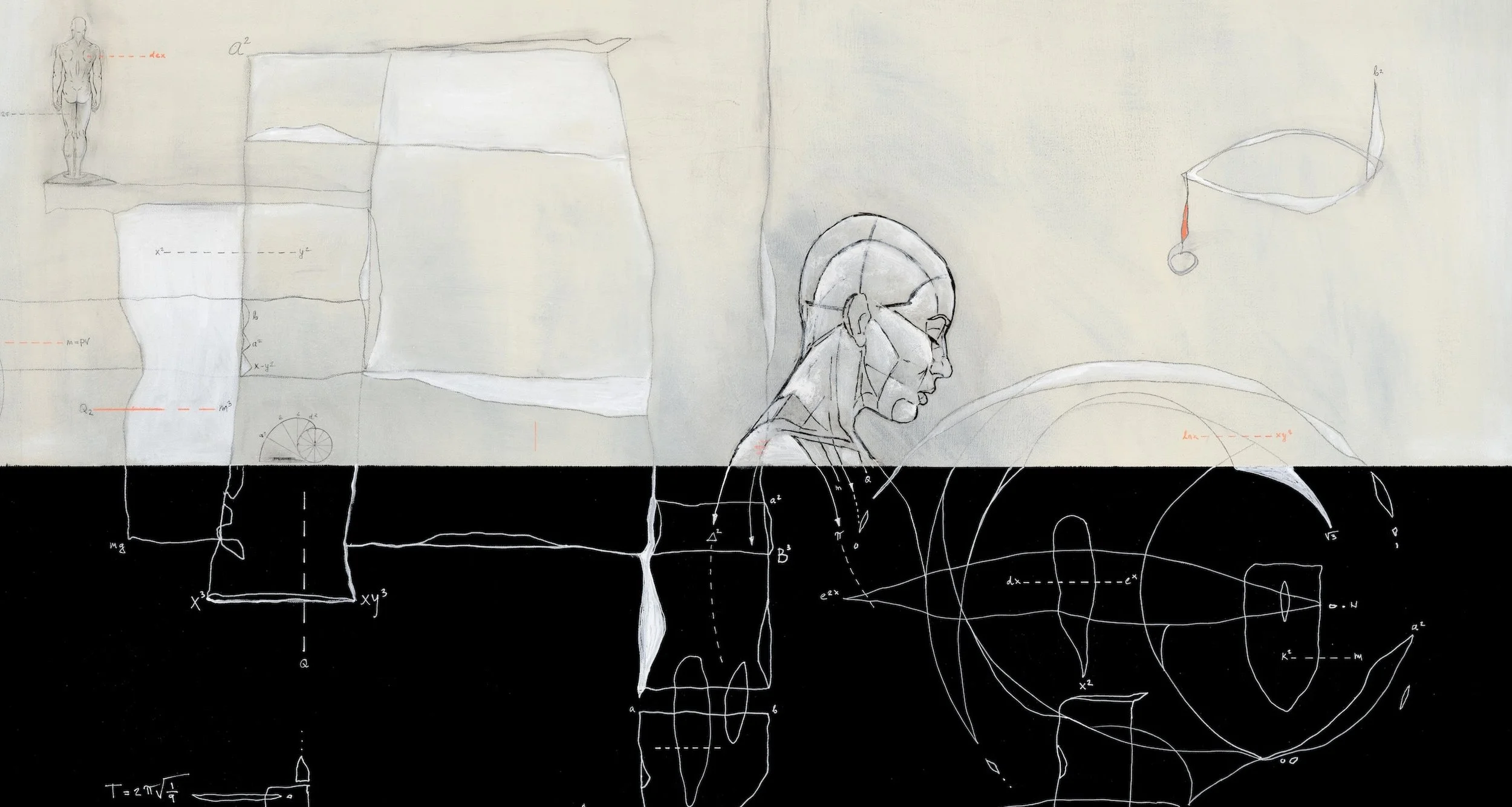

Noon Spiegel’s art reveals the human figure as both equation and experience. It is organized by sequences and ratios, yet capable of profound emotional resonance. It is shaped by systems, yet capable of reshaping them.
By uniting mathematical precision with embodied intimacy, Spiegel constructs a vision of gender and humanity that is neither rigid nor chaotic. It is relational, measured, and deeply alive—an architecture of identity where geometry and emotion coexist in deliberate, dynamic balance.
NOON SPIEGEL ON SACRED GEOMETRY AND AESTHETIC EXPERIENCE
Interview with Widewalls Magazine
All of our visible and invisible world is ruled by geometric proportions. However, mathematical laws rarely inspire artists, who usually rely on different phenomenological manifestations in their art.
Among contemporary artists who recently turned their interest towards precisely this not-so-artistic material of mathematical ratios is Noon Spiegel, an American artist from New York, represented by Oliver Cole Gallery.
Spiegel's recent series explores the golden ratio, the Fibonacci sequence, binary code, and sacred geometry in paintings that combine abstraction and figuration. Like the invisible rules behind everything in our reality, Spiegel's paintings are mathematically precise in formal application while preserving the aesthetic effect of unbridled expression.
Resembling both a jumbled mathematical equation and engineering schema, the works can be seen as blueprints of the world's DNA, filled with ancient human-made forms, anatomical drawings of the human body in different positions, and geometrical structures, all extracted from our material and immaterial reality.